Sai Haneesh Allu

Sai Haneesh Allu

Ph.D. Candidate in Computer Science

Intelligent Robotics and Vision Lab · UT Dallas
saihaneesh.allu@utdallas.edu

On the job market. I'm seeking full-time research and engineering positions in robotics. → Let's talk

Robots that work outside the lab.

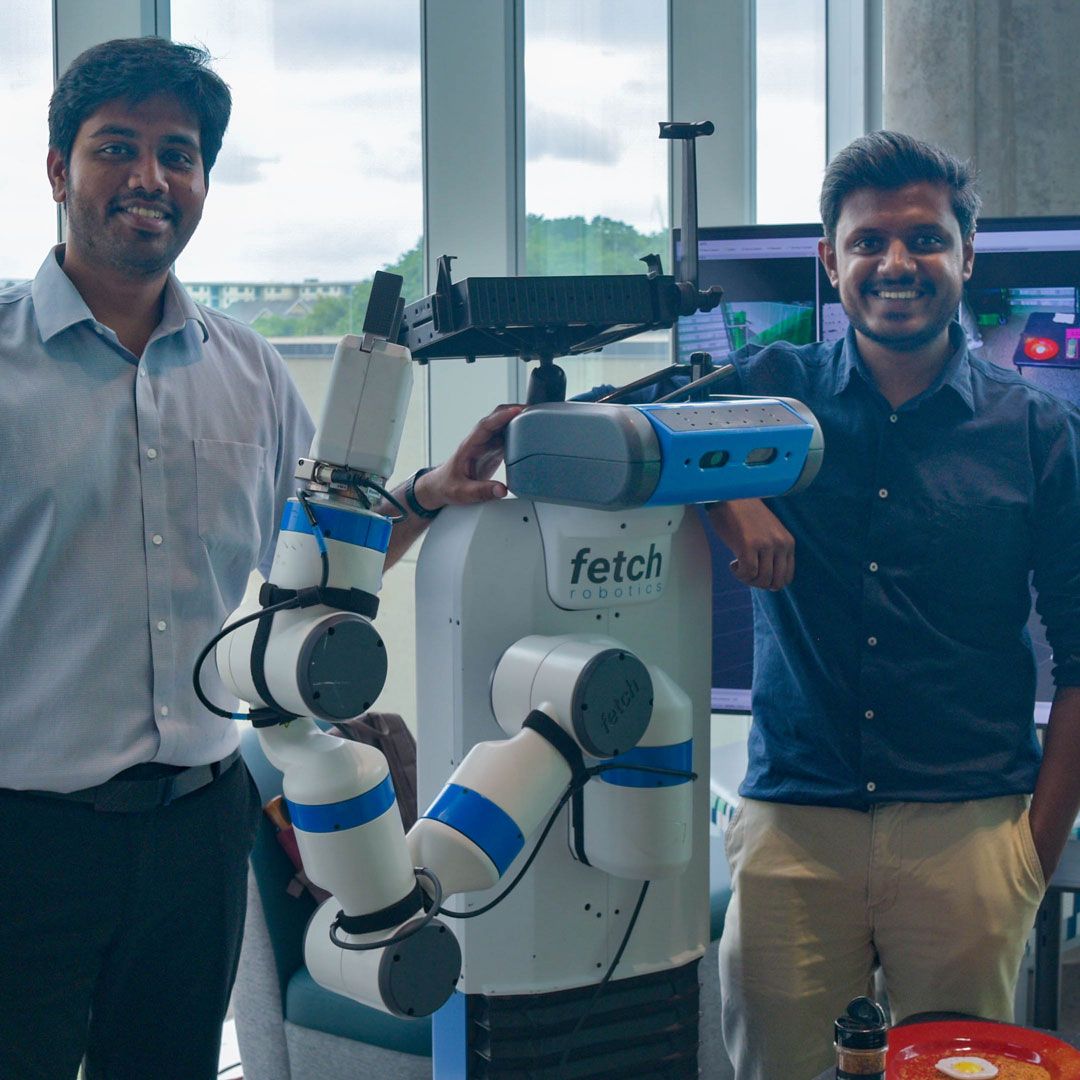
I am a Ph.D. candidate in Computer Science at UT Dallas, advised by Dr. Yu Xiang in the Intelligent Robotics and Vision Lab. I work on autonomous mobile manipulation frameworks for robots to navigate unfamiliar spaces, grasp novel objects, and execute manipulation tasks without prior instruction. Everything is built and tested on physical hardware.

My research tackles each of these challenges through three key projects: SceneReplica , a reproducible benchmark for robot grasping and manipulation; AutoX-SemMap, a modular system for navigating large-scale unknown environments and maintaining live semantic maps; and HRT1, mobile manipulation learned from a single human demonstration video.

Prior to my Ph.D., I co-founded VECROS Technologies, where I led the development of autonomous quadrotor systems. I hold Master's in Control & Automation from IIT Delhi and Bachelor's in Electrical & Electronics Engineering from NIT Warangal. I am drawn to problems where research must survive contact with real hardware.

News

Publications

* denotes equal contribution and joint lead authorship.

HRT1: One-Shot Human-to-Robot Trajectory Transfer for Mobile Manipulation
Sai Haneesh Allu*, Jishnu Jaykumar P*, Ninad Khargonkar, Tyler Summers, Jian Yao, Yu Xiang
arXiv preprint · Under review
We introduce a novel system for human-to-robot trajectory transfer that enables robots to manipulate objects by learning from human demonstration videos. The system consists of four modules: a data collection module that collects human demonstration videos from the point of view of a robot using an AR headset; a video understanding module that detects objects and extracts 3D human-hand trajectories; a transfer module that converts a human-hand trajectory into a reference trajectory of a robot end-effector in 3D space; and a trajectory optimization module that solves for a trajectory in the robot configuration space following the transferred end-effector trajectory. Together, these modules enable a robot to watch a human demonstration video once and then repeat the same mobile manipulation task in different environments, even when objects are placed differently from the demonstrations.
@article{2025hrt1, title = {HRT1: One-Shot Human-to-Robot Trajectory Transfer for Mobile Manipulation}, author = {Allu, Sai Haneesh and P, Jishnu Jaykumar and Khargonkar, Ninad and Summers, Tyler and Yao, Jian and Xiang, Yu}, journal = {arXiv}, year = {2025} }
From Local Matches to Global Masks: Template-Guided Instance Detection and Segmentation in Open-World Scenes
Qifan Zhang, Sai Haneesh Allu, Jikai Wang, Yangxiao Lu, Yu Xiang
RSS 2026 · Robotics: Science and Systems
Detecting and segmenting novel object instances in open-world environments is a fundamental problem in robotic perception. Given only a small set of template images, a robot must locate and segment a specific object instance in a cluttered, previously unseen scene. Existing proposal-based approaches are highly sensitive to proposal quality and often fail under occlusion and background clutter. We propose L2G-Det, a local-to-global instance detection framework that bypasses explicit object proposals by leveraging dense patch-level matching between templates and the query image. Locally matched patches generate candidate points, which are refined through a candidate selection module to suppress false positives. The filtered points are then used to prompt an augmented Segment Anything Model (SAM) with instance-specific object tokens, enabling reliable reconstruction of complete instance masks. Experiments demonstrate improved performance over proposal-based methods in challenging open-world settings.
@inproceedings{zhang2026localmatchesglobalmasks, title = {From Local Matches to Global Masks: Novel Instance Detection in Open-World Scenes}, author = {Qifan Zhang and Sai Haneesh Allu and Jikai Wang and Yangxiao Lu and Yu Xiang}, booktitle = {Robotics: Science and Systems (RSS)}, year = {2026} }
A Modular Robotic System for Autonomous Exploration and Semantic Updating
Sai Haneesh Allu, Itay Kadosh, Tyler Summers, Yu Xiang
arXiv preprint · Under submission
We present a modular robotic system for autonomous exploration and semantic updating of large-scale unknown environments. Our approach enables a mobile robot to build, revisit, and update a hybrid semantic map that integrates a 2D occupancy grid for geometry with a topological graph for object semantics. Unlike prior methods that rely on manual teleoperation or precollected datasets, our two-phase approach achieves end-to-end autonomy: first, a modified frontier-based exploration algorithm with dynamic search windows constructs a geometric map; second, using a greedy trajectory planner, environments are revisited and object semantics are updated using open-vocabulary object detection and segmentation. This modular system, compatible with any metric SLAM framework, supports continuous operation by efficiently updating the semantic graph to reflect short-term and long-term changes such as object relocation, removal, or addition. We validate the approach on a Fetch robot in real-world indoor environments of approximately 8,500m² and 117m², demonstrating robust and scalable semantic mapping and continuous adaptation.
@article{allu2024modular, title = {A Modular Robotic System for Autonomous Exploration and Semantic Updating}, author = {Allu, Sai Haneesh and Kadosh, Itay and Summers, Tyler and Xiang, Yu}, year = {2026} }
Grasping Trajectory Optimization with Point Clouds
Yu Xiang, Sai Haneesh Allu, Rohith Peddi, Tyler Summers, Vibhav Gogate
IROS 2024Oral
We introduce a new trajectory optimization method for robotic grasping based on a point-cloud representation of robots and task spaces. Robots are represented by 3D points on their link surfaces, and the task space is represented by a point cloud obtained from depth sensors. Using this representation, goal reaching in grasping can be formulated as point matching, while collision avoidance is efficiently achieved by querying the signed distance values of the robot points in the signed distance field of the scene points. Consequently, a constrained nonlinear optimization problem is formulated to solve the joint motion and grasp planning problem. The advantage of our method is that the point-cloud representation is general enough to be used with any robot in any environment. We demonstrate the effectiveness of our method on a tabletop scene and a shelf scene for grasping with a Fetch mobile manipulator and a Franka Panda arm.
@inproceedings{xiang2024grasping, title = {Grasping Trajectory Optimization with Point Clouds}, author = {Xiang, Yu and Allu, Sai Haneesh and Peddi, Rohith and Summers, Tyler and Gogate, Vibhav}, booktitle = {IROS}, year = {2024} }
SceneReplica: Benchmarking Real-World Robot Manipulation
Ninad Khargonkar*, Sai Haneesh Allu*, Yangxiao Lu, Jishnu Jaykumar P, Balakrishnan Prabhakaran, Yu Xiang
ICRA 2024Oral
We present a new reproducible benchmark for evaluating robot manipulation in the real world, specifically focusing on a pick-and-place task. Our benchmark uses the YCB object set, a commonly used dataset in the robotics community, to ensure that our results are comparable to other studies. The benchmark is designed to be easily reproducible in the real world, making it accessible to researchers and practitioners. We also provide experimental results and analyses for model-based and model-free 6D robotic grasping, where representative algorithms are evaluated for object perception, grasp planning, and motion planning. By providing a standardized evaluation framework, researchers can more easily compare different techniques and algorithms, leading to faster progress in developing robot manipulation methods.
@inproceedings{khargonkar2024scenereplica, title = {SceneReplica: Benchmarking Real-World Robot Manipulation}, author = {Khargonkar, Ninad and Allu, Sai Haneesh and Lu, Yangxiao and P, Jishnu Jaykumar and Prabhakaran, Balakrishnan and Xiang, Yu}, booktitle = {ICRA}, year = {2024} }
Formation Control of Quadcopters
Sai Haneesh Allu
M.S. Thesis, IIT Delhi, 2020
This study investigates various formation control algorithms and implements them on an experimental platform, with the ultimate goal of target interception by choosing the best-suited algorithm. The open-source nanoquadcopter platform Crazyflie 2.0 was chosen for experimentation, and the ArduPilot flight stack along with DroneKit software-in-the-loop were used for simulation. The work studies virtual structure, leader-follower, and graph-theoretic methods of formation control, designs controllers for each, and compares their performance in formation maintenance. The comparison shows that the graph-theoretic method is best suited for formation maintenance, and target interception is simulated using this method. Velocity- and trajectory-based formation control via optimization techniques are proposed as future work.

Industry Experience

2020 – 2021
VECROS Technologies
Co-Founder & CTO
Developed an edge-processed Visual Inertial Odometry system and a mapless reactive planner for GPS-denied navigation. Led the team in building a web-based BVLOS control platform using AWS IoT.
2016 – 2017
Sterlite Technologies
Operations Engineer
Investigated the optical fiber spooling process and implemented a grounding mechanism to reduce process failures.

Service & Teaching

Organizer
Workshop on Neural Representation Learning for Robot Manipulation (CoRL 2023)
Reviewer
IROS 2024, ICRA 2025, ICRA 2026
Teaching
UT Dallas: Computer Graphics, Human-Computer Interaction
IIT Delhi: Stochastic Filtering, Multi-Agent Control, Advanced Control Lab